
Reading time: 5 minutes
You are a professor of textile finishing and ecology at the Niederrhein University of Applied Sciences and also head the Research Institute for Textiles and Clothing. Can you explain what your current teaching and research focuses are?
The research institute was founded in 2009 in response to the Bologna Process, when German universities converted their diploma programs to bachelor's and master's programs. Since master's programs are intended to prepare students more intensively for research and development, we wanted to create a structure at our university of applied sciences that would enable academic further qualification. The institute thus initially arose from teaching. Early on, there was a clear need for research, development, and, above all, transfer — especially in the small and medium-sized enterprises of our textile industry. Until then, many companies had no access to practical research, as basic research was mainly carried out at universities. The originally teaching-oriented idea therefore developed into an institution that strongly addresses the needs of industry. Today, around 60 people work at the institute. A major advantage is that our students are closely involved. In addition to textile and clothing engineers, researchers from the disciplines of chemistry, biology, physics, marketing, and logistics work with us – an enrichment for the entire teaching program. Students can write research and theses and, if they perform well, even earn some extra money as assistants. It's a real win-win situation.

What motivates students to choose this field of study?
Many have a keen interest in fashion and textiles—often combined with the desire to start their own label or work in an aesthetically demanding industry. The interesting combination of material aesthetics, quality, technical science, and social factors plays a major role in this. Other students come from regions with a strong textile background and are familiar with local companies. They are particularly interested in technical textiles and want to develop innovative products – less so in classic fashion and home textiles.
Textilfabrik 7.0 recently received significant funding from the federal government and the state of North Rhine-Westphalia. What is this about?
Textilfabrik 7.0 is a transfer center that aims to further develop research results that have not yet made their way into industry and make them marketable. Many good ideas only make it as far as scientific publications and are not implemented. Our goal is to specifically promote these approaches and translate them into concrete products and processes. To this end, we want to encourage start-ups to use the center, but also motivate established companies to spin off. The overarching goal is to create new jobs by fostering an innovative and strengthened textile and clothing industry.
Textilfabrik 7.0 is a transfer center that aims to further develop research results that have not yet made their way into industry and make them marketable.
What are the biggest challenges for a sustainable textile supply chain?
The central problem in the fashion industry is overproduction. If we could reduce this, it would be a huge step forward for sustainability. However, the global supply chains that have emerged in recent decades systematically encourage this: for safety reasons, disproportionate quantities are ordered to avoid supply bottlenecks. This means that overproduction is practically a given. Added to this is the great geographical distance: many companies have no direct insight into production conditions or environmental impacts. For consumers, much of this remains invisible. With the Green Deal, the EU pursued very ambitious goals – from lower-emission production to a circular economy and durable products. Currently, individual goals are being watered down so as not to overburden industry. I now tend to refer to it as a “Lean Deal.” Nevertheless, important impulses are emerging, for example for quality, durable products, and recycled raw materials. At Textile Factory 7.0, we want to demonstrate functioning cycles, work on biotechnological raw materials, and address the issue of microplastics, among other things.
An important component will be on-demand production – linked to microfactory engineering, automation, and AI.
Agile, regional, or national production units could counteract overproduction. However, this is ambitious in view of advancing globalization.
How do you view the European situation in an international context?
Europe sets important standards and can exert global influence through norms. But we should be realistic about our role: China dominates the textile value chain, especially in fibers, and can therefore dictate prices. Europe has relinquished its technological leadership and is now predominantly a consumer, no longer a producer. This means that many European initiatives have only a limited international impact. At the same time, pressure from Asian direct sales is increasing. It is therefore crucial to strengthen European production and promote innovation in a targeted manner. This is particularly important in areas where Germany and Europe as a whole are still strong, namely in the technical textiles product segment.
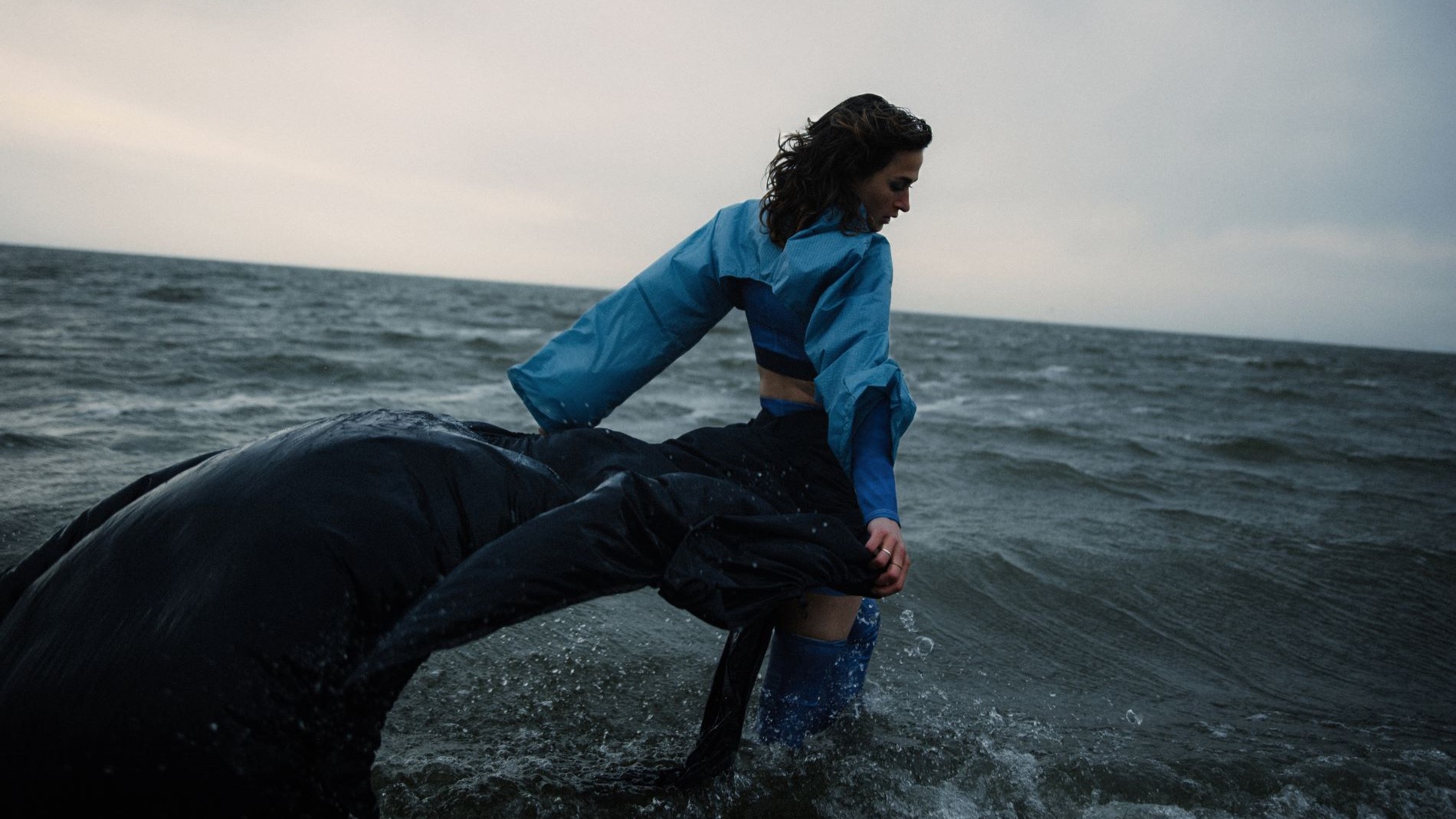
tides – between nature and technology
tides is a master’s collection by Antonia Dannenberg, B. Sc., B.Sc. (Master Textile Products – Clothing Technologies) exploring the impact of climate change on the oceans. Based on biophilia and bionics, the designs combine innovative 3D printing with upcycling of discarded kites and surplus materials.







What are you currently working on?
The biggest project at the moment is Textile Factory 7.0. At the same time, I am working on integrating sustainability and sustainability management more strongly into teaching – always in conjunction with basic technical knowledge. Without technical understanding, sustainability cannot be managed effectively. We are also increasingly promoting start-up ideas from the student body. On the research side, my focus is on chemical recycling and bio-based polymers – fibers that are made from waste and produced using biotechnological processes. For me, these are key topics for the future.
Header photo: © Pixel & Korn